The Invisible Power of Transcriptions
Publicado el 3 February 2026
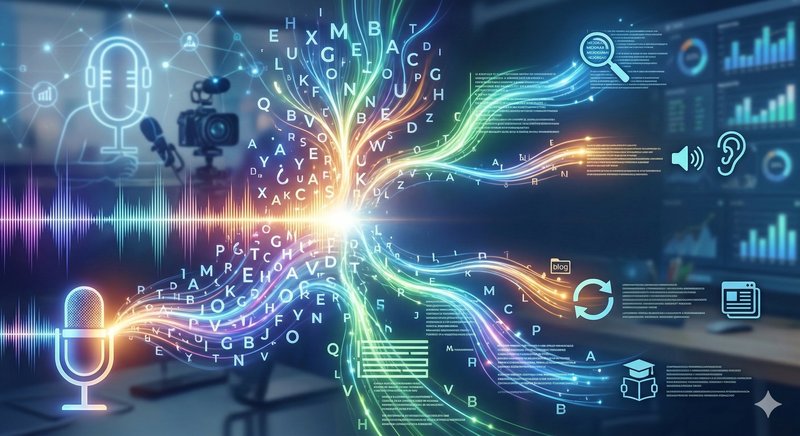
Why Converting Voice to Text Will Transform Your Content
We are living in the golden age of audiovisual content. Podcasts, webinars, YouTube videos, and voice notes dominate our daily attention. However, in the midst of this sonic and visual revolution, there is a silent hero that we often overlook: written text.
If you create content and aren't transcribing your audio and video, you are leaving money, audience, and opportunities on the table. Below, we explore why transcriptions are not just an optional "extra," but a fundamental piece of any modern digital strategy.
1. The Ultimate Boost for Your SEO (Search Engine Optimization)
No matter how advanced Google's algorithms become, search engines are still, at their core, "blind readers." They cannot listen to your masterful podcast episode or see the slides of your latest webinar with the same depth as they analyze text.
By transcribing your content, you are giving Google exactly what it needs:
-
Natural Keywords: Your spoken word is full of the exact phrases your audience is searching for (long-tail keywords).
-
Deep Indexing: A one-hour video turns into thousands of indexable words, exponentially increasing your chances of appearing in search results.
-
Increased Dwell Time: Users who read the transcript while listening to the audio spend more time on your website—a positive signal for search engines.
2. Accessibility and Inclusion: Content for Everyone
Educational and high-value content should be for everyone. Transcriptions break down massive barriers:
-
Hearing Impaired Individuals: You make your content accessible to millions of people worldwide.
-
Silent Consumption: 85% of social media videos are watched without sound. If your user is on public transport or in an office, a transcript allows them to consume your message without turning on the speaker.
-
Language Barriers: Reading is often easier than listening for non-native speakers, as they can translate the text or look up words they don't understand at their own pace.
Important Note: Accessibility is not just an ethical best practice; in many countries, it is a legal requirement for digital platforms.
3. Retention and Educational Comprehension
From a purely educational standpoint, combining audio with text is one of the most effective ways to teach.
Different people have different learning styles; some are auditory, others are visual. Offering a transcript enables dual processing. When a student or follower can read while listening, information retention skyrockets. Furthermore, it greatly facilitates note-taking and searching for key concepts within a long talk.
4. The Art of Content Repurposing
Creating good content takes time and effort. Transcription is the ultimate fuel for content recycling. From a single transcribed audio file, you can generate:
-
Multiple blog posts diving deeper into the topics discussed.
-
Twitter (X) threads or LinkedIn posts featuring the most impactful quotes.
-
Weekly newsletters for your subscribers.
-
E-books or downloadable guides compiling various interviews.
Don't let your best ideas get lost in the wind. Transcribe, optimize, and reach more people.
Get Started Now
Join our platform now and start transcribing securely.